A Google Business Profile is not a replacement for a website.
A website is not a replacement for a Google Business Profile either.
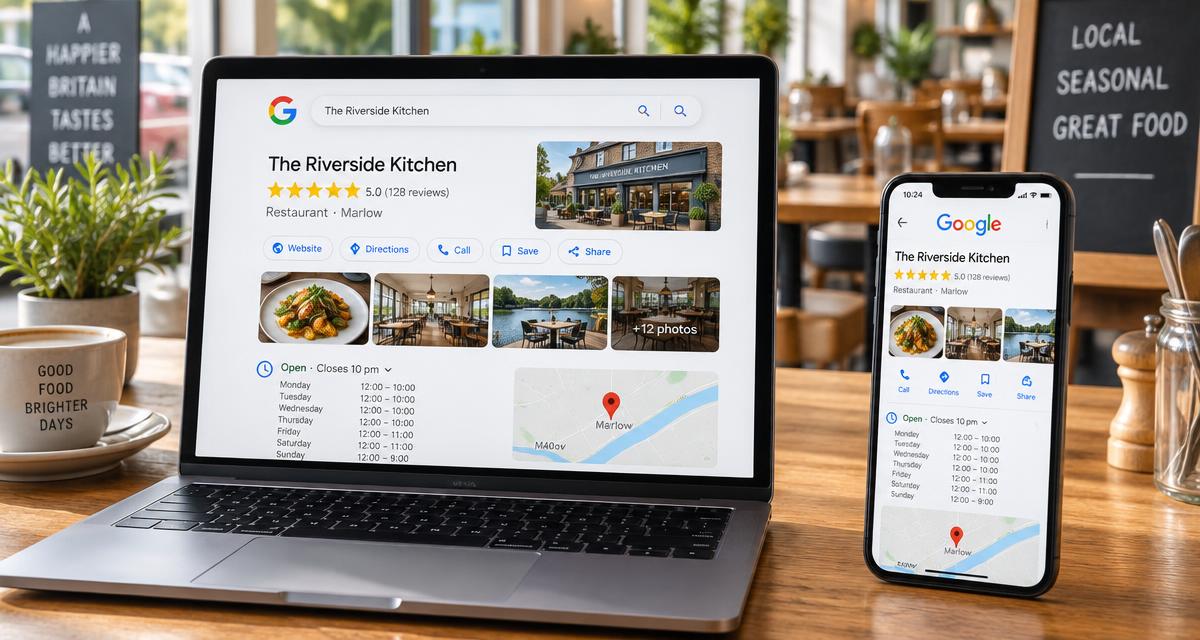
They meet customers at different points. Your Google profile can introduce your business when someone is searching in Google or looking at Maps. Your website gives that person somewhere to go when they want to know a little more before deciding whether to call, book, visit or buy.
For a local business with limited time and budget, that makes them a useful pair. A Google Business Profile is free, and OneLuton is currently free to build and publish while we're growing, with no payment card required.
Neither guarantees that you will appear at the top of Google. What they can do is make it easier for people to find accurate information about your business and decide what to do next.
They have different jobs
Imagine someone searching for a café, electrician or beauty salon nearby.
Your Google profile gives them a quick picture of the business. They can see your category, location or service area, opening hours, telephone number, photographs and reviews. That may be enough for someone who already knows what they need.
But sometimes people need a little more.
A café might need somewhere to show its current menu. An electrician might want to explain the types of work they take on and the areas they cover. A salon might want customers to see its treatments, prices and booking options.
That's where the website comes in.
Your Google profile helps someone find and assess the business. Your website gives them the information they need to take the next step.
Start with the details on your Google profile
Google asks businesses to verify their profiles, and the verification method available can vary from one business to another.
Once your profile is verified, it is worth spending a little time on the details rather than treating it as a box you've simply ticked.
Choose the primary category that most closely describes what you actually do. Keep your opening hours and holiday hours accurate. If customers visit your premises, make sure the address is correct. If you travel to customers instead, use a genuine service area.
Add photographs that represent the business as it is today, not how it looked three years ago.
Your description doesn't need to sound clever either. Tell people what you do, where you work and who you serve in ordinary language.
And make sure the website link takes people somewhere useful. If you have a page specifically about your main service, for example, that may be more helpful than sending every visitor to a generic homepage.
Let your website answer the next question
Finding your business is only the first part.
A customer who has seen your Google profile may still be wondering:
- Do you offer the exact service I need?
- Do you cover my area?
- How much does it cost, or how do I request a quote?
- Can I see examples of your work?
- How do I book or get in touch?
Your website should make those answers easy to find.
You don't need dozens of pages to do this. A small business can often do a lot with a clear homepage, a few useful service details, photographs, contact information and whatever other information customers regularly ask about.
Write for the person who has just found you, rather than trying to fill the page with search phrases.
A useful page about a real service you provide is much more valuable than several thin pages that simply swap "Luton" for "Dunstable", "Houghton Regis" and other nearby places.
For more on this part of the customer journey, see our guide to how local customers find businesses on Google.
There is nothing particularly complicated about this, but it is easy to overlook.
Your business name, telephone number, opening hours and location details should make sense wherever a customer finds you.
If Google says you're open until 6pm but your website says 5pm, someone deciding whether to visit shouldn't have to work out which one is right.
The same applies if you change your phone number, move premises, change your opening hours or stop offering a particular service.
Make the update in both places.
It is worth putting a reminder in your calendar to check your details every few months, and definitely before Christmas, bank holidays or any other period when your normal opening hours change.
Reviews should be genuine
Reviews can help a potential customer feel more confident about contacting a business they've never used before.
You don't need a complicated system for asking for them. If you've completed a job or served a customer and they've had a genuine experience with your business, simply ask whether they'd be willing to leave an honest review.
For example:
Thank you for choosing us. If you have a moment, we'd really appreciate an honest review of your experience.
Keep it that simple.
Don't pay for positive reviews, ask people to write something they don't genuinely believe or create reviews yourself. Google has policies against fake engagement and review manipulation, and customers can usually tell when a collection of reviews doesn't look natural.
A smaller number of genuine reviews is far more useful than a sudden collection of identical praise.
And when someone does leave a review, take a moment to respond. You don't need a long reply. A genuine thank you, or a calm response to a problem, is part of what future customers will see.
Make the connection obvious
Once both are set up, the practical connection is straightforward.
Your Google profile should link to your website. The website should clearly show the same main contact details and the services or locations described on the profile.
If someone is looking at your business on their phone, they should also be able to call, message, book or make an enquiry without having to search around for the right button.
You can also put your website address on invoices, social profiles, business cards and other places where existing customers might come across it.
You don't need some complicated technical connection between Google and your website.
They simply need to tell the same story.
Where OneLuton fits in
OneLuton helps with the website side of this.
You can create and publish a simple business website with your services, contact details, photographs, galleries, reviews and clear ways for customers to get in touch. If you work in a trade, our website option for tradespeople adds a tap-to-call button and a quote request form from the start.
The editor also includes basic SEO controls such as page titles, meta descriptions, an SEO image and a search indexing setting. OneLuton can generate a first draft of sections and wording too, but you should always check it and replace anything that doesn't accurately describe your business.
The important thing is that the website remains yours. You provide the real information, photographs, services and contact details that customers need.
Your Google Business Profile remains separate. You manage that through Google, and OneLuton does not create, verify or synchronise it for you.
And like any website builder, OneLuton cannot promise when Google will index a page or where it will appear in search results.
Give yourself an hour
You can make a useful start without turning this into a full-day SEO project.
- Check your Google category, opening hours, phone number and service area.
- Add a few recent photographs if the ones there are out of date.
- Make sure your website is linked from the profile.
- Open the website on your phone and actually try the contact or booking actions.
- Check that your services and locations are accurate in both places.
- And if you've recently had a happy customer, ask them for an honest review.
Then leave it alone for a while and keep the information current as your business changes.
For most local businesses, being visible online isn't about finding one clever SEO trick. It is about making sure that when someone is looking for a business like yours, they can find you, understand what you do, see some evidence that you're genuine and take the next step without having to work too hard for it.