If you run a small business, you've probably Googled yourself at some point.
Maybe you searched for "plumber in Luton", "barber near me" or "best takeaway in Luton" and wondered why one business appears at the top while yours is nowhere to be seen.
It can feel like Google has some secret formula that only SEO experts understand.
The good news is that it isn't quite that mysterious.
When somebody searches for a local business, Google is mainly trying to work out three things: is this business relevant to what they're looking for, is it actually nearby, and does it look like a business they can trust?
There are a few different things that help Google answer those questions.
How Google finds local businesses
Google looks at many signals to decide which businesses to show for a local search. It checks how relevant your website and profile are to the search, how close you are to the person searching, and how trustworthy your business appears based on reviews, mentions and the quality of your information.
First, there are two places you can appear
When you search for something like "electrician in Luton", you'll often see a map with a few businesses near the top. That's the Google Maps results, sometimes called the map pack.
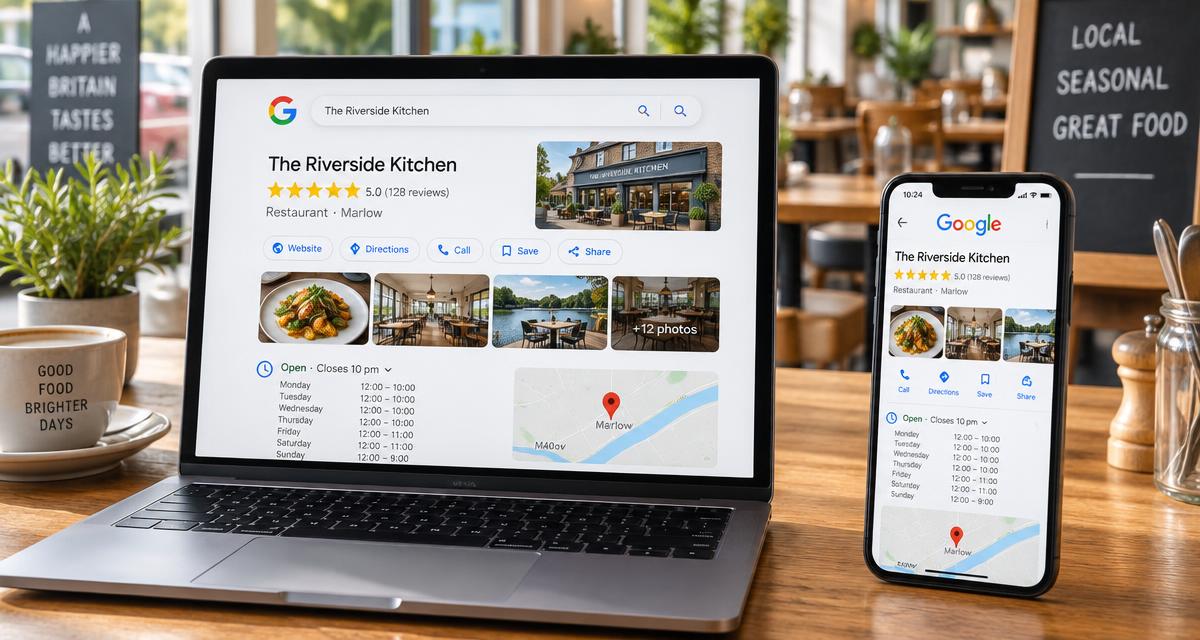
Your Google Business Profile plays a big part here. Your location, opening hours, services, photos and reviews all help Google understand your business and decide when it might be useful to show you.
Then there are the normal search results underneath.
This is where your website matters.
If someone searches for "boiler repair in Luton", for example, Google needs to find websites that clearly explain what the business does, where it operates and whether the page is genuinely useful to someone looking for a boiler repair.
That's why having a website that simply says "Welcome to John's Services" isn't always enough. Google needs context. More importantly, your customers need context too.
Your website needs to tell people what you actually do
Think about your website from the point of view of someone who has never heard of you. If you're a mobile mechanic who works across Luton, what would you want a potential customer to know?
Probably something like:
- What services do you offer?
- Which areas do you cover?
- How can I contact you?
- Do you come to my home or workplace?
- How much does it usually cost?
- Can I trust you?
- How quickly can you come out?
Those are the same sorts of details that make a website useful to Google.
Your page title, headings and written content all give Google clues about what your business does. Your location and service areas give it more context. Structured information on the site can help search engines understand that the website represents a real local business.
You don't need to repeat "Luton" 47 times on the page. In fact, please don't. Just be clear.
If you repair boilers in Luton, say that naturally. If you cover Dunstable and Stopsley as well, say that too. If you only work on commercial properties, make that clear.
Write for the person who needs your service first. Google comes second.
If you're on the road or running a trade van, our websites for tradesmen show how a mobile-ready call button and quote form usually fit together.
Your Google Business Profile matters too
Your website isn't the whole picture.
For many local searches, your Google Business Profile is just as important, sometimes more important, because it is what people see when they're looking at businesses on Maps.
Make sure the basics are right:
- Your name.
- Your address or service area.
- Your opening hours.
- Your phone number.
- Your services.
- Your photos.
- And, perhaps most importantly, your reviews.
A business with a handful of genuine, recent reviews can look very different from one with hundreds of reviews that haven't changed in two years.
You don't need to pressure every customer into leaving a five-star review. A simple message after you've done a good job is often enough:
Thanks for choosing us. If you were happy with the service, we'd really appreciate a quick Google review.
Make it easy for people to leave one.
Don't create a page for every possible keyword
This is where SEO advice can get unnecessarily complicated.
You might hear that you need to create dozens of pages targeting slightly different searches. You usually don't.
If you offer three main services, it can make much more sense to have three genuinely useful pages that explain those services properly. For example:
- Boiler repairs in Luton
- Boiler servicing in Luton
- Central heating installation in Luton
Each page can explain what you offer, who it's for, the areas you cover and what someone can expect when they contact you.
That's much more useful than writing one enormous page that tries to talk about everything. And it's certainly better than filling a page with awkward sentences like:
Looking for the best boiler repair Luton? Our Luton boiler repair Luton team provides boiler repair Luton...
Google isn't fooled by that. Neither are your customers.
Reviews aren't just about stars
Reviews do more than make your business look good.
They can also give potential customers confidence before they contact you. Think about the difference between:
★★★★★Great service.
and:
★★★★★Called in the morning because our boiler stopped working. He came out that afternoon, explained what was wrong and had it working again before dinner.
The second one tells a potential customer something. It tells them what happened, how quickly the business responded and what kind of experience they can expect.
So when you're asking customers for reviews, don't worry about getting a particular phrase into them. Just encourage genuine feedback. Real experiences are much more valuable than reviews that sound like they were written for Google.
What about AI search?
There's another reason it's worth making your website clear and useful. People are increasingly asking questions through AI tools as well as traditional search engines.
- "Who can fix my boiler in Luton?"
- "What's the best way to get my car serviced locally?"
- "Find me a barber near Stopsley that's open on Sunday."
The technology behind these answers is different from traditional Google search, but the basic principle is surprisingly similar. The businesses most likely to be useful are the ones whose information is clear, specific and easy to understand.
- What do you do?
- Where do you work?
- When are you open?
- How can someone contact you?
- What makes you different?
Answer those questions properly on your website and you're not just helping Google. You're helping a real person decide whether you're the right business for them.
So, how long does it take?
This is the part nobody likes hearing. There isn't a guaranteed timeline.
A new website can be discovered and indexed relatively quickly, but that doesn't mean you'll suddenly appear at number one for "plumber Luton" next Tuesday.
Some less competitive, more specific searches can start bringing visibility sooner. More competitive searches can take considerably longer. And your position can change as Google updates its results and as other local businesses improve their own websites and profiles.
So don't obsess over checking your ranking every morning. Instead, get the basics right and keep them right.
- Make sure your information is accurate.
- Keep your Google Business Profile updated.
- Add useful information to your website.
- Collect genuine reviews.
- Keep your contact details consistent.
And make it ridiculously easy for someone who finds you online to understand what you do and get in touch.
You don't need to become an SEO expert
That's probably the most important thing to take away.
You don't need to spend your evenings learning about algorithms, backlinks and technical SEO.
You need to make sure that when someone in Luton is looking for the service you provide, Google has enough clear information to understand that you exist, and the customer has enough information to want to contact you.
We see the same pattern with local businesses in Luton and Bedford: an accurate profile and a clear website, kept consistent, does most of the work.
That's a much simpler job. And it's one worth doing well.