Starting a business is one thing.
Getting people to actually find you is another.
If you're a plumber in Luton, a barber in Stopsley, a tutor in Leagrave or a mobile mechanic covering Bedfordshire, you don't necessarily need a complicated digital strategy.
You need to make a few things work together.
People need to be able to find you.
They need to understand what you do.
They need to feel that you're legitimate and trustworthy.
And when they're ready to contact you, they need to know exactly how.
That's really what getting your business online is about.
You don't need to do everything at once either. In fact, trying to do everything at once is usually a good way to spend money without getting much back.
Here's where we'd start.
1. Start with what you want customers to do
Before you worry about colours, logos or social media, ask yourself one simple question:
What do I actually want someone to do when they find my business online?
Maybe you want them to call you.
Maybe you want them to request a quote.
Maybe they need to book an appointment.
Maybe you want them to visit your shop.
Whatever it is, make that the main action on your website.
If someone has to hunt around to work out how to contact you, you've made things harder than they need to be.
You can still have other things on your site, of course. Information about your services, photos, reviews, your story and so on.
But there should be a clear next step.
You don't need to write a 2,000-word business plan before creating your website.
Start with the basics.
Write down:
- What you do, in one sentence that someone who has never heard of you would understand.
- The areas you cover. For example, Luton, Dunstable, Houghton Regis or specific neighbourhoods.
- Your three to six main services.
- Your opening hours.
- Your phone number and email address.
- Your address, if customers visit you.
- A few genuine reasons someone might choose you over another business.
Don't overthink that last one.
It could be years of experience.
It could be that you offer same-day appointments.
It could be that you are a family-run business.
It could be that you don't charge call-out fees.
It could simply be that customers regularly tell you how good your service is.
These details are useful because they give people something to judge your business on.
3. Build a simple website
You don't need a huge website to get started.
For many local businesses, five good pages can be more useful than twenty pages of filler:
Home
A quick introduction to what you do, where you work and how someone can contact you.
Services
The main things you offer, explained in plain English.
About
A little about you and the business. People like knowing who they're dealing with, particularly when they're inviting someone into their home.
Reviews or examples of your work
Give people some reassurance before they contact you.
Contact
Make it easy to call, message, email or request a quote.
And make sure the site works properly on a phone.
Someone searching for an emergency plumber isn't necessarily sitting at a desk with a laptop. They might be standing next to a leaking boiler with their phone in one hand.
Your website needs to work for that person.
4. Get your Google Business Profile right
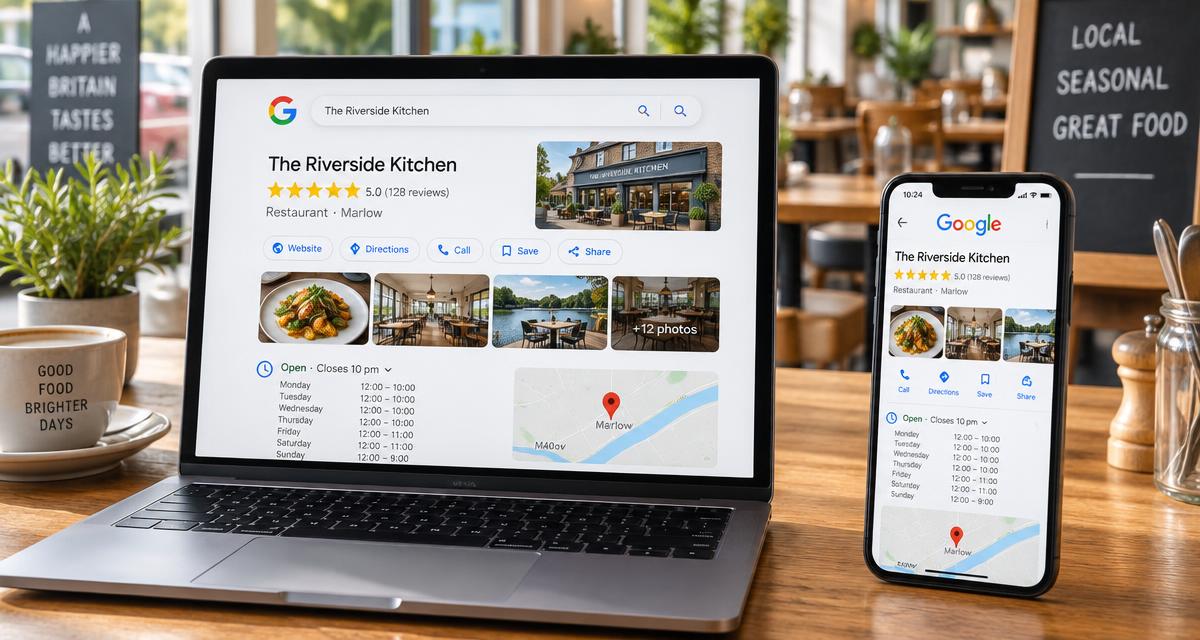
Once your website is live, make sure your Google Business Profile is properly set up too.
This is one of the first places people will see your business when they search locally.
- Fill in the details.
- Add your services.
- Add real photos.
- Keep your opening hours up to date.
- Make sure your phone number is correct.
- Link to your website.
If you operate from a physical location, make sure your address is accurate. If you travel to customers instead, make sure your service area is properly represented.
And don't create a profile just to forget about it.
Businesses change. Opening hours change. Services change. New photos become available. Keep the information current.
This sounds obvious, but it's surprisingly easy to get wrong.
- Put your phone number somewhere people can see it.
- Make it clickable on mobile.
- If you use WhatsApp for enquiries, make that an option.
- If you prefer a contact form, keep it short.
You probably don't need someone's full address, date of birth, company registration number and favourite colour before they can ask for a quote.
Ask for what you actually need.
Every unnecessary step gives someone another opportunity to give up.
And if your business is the kind where people usually want to call, don't hide the phone number behind a tiny "Contact us" button at the bottom of the page.
Make the obvious thing obvious.
6. Start collecting genuine reviews
Reviews are one of the simplest ways to help someone feel comfortable choosing a local business.
But don't wait for customers to remember to leave one.
If you've just finished a job and the customer is happy, that's a good time to ask.
You don't need a complicated campaign.
A simple message can do it:
Thanks for choosing us. If you were happy with the service, we'd really appreciate a quick review.
Then give them the link.
That's it.
And when reviews come in, respond to them.
Thank people who leave positive reviews. If someone has had a bad experience, respond professionally rather than ignoring them.
A potential customer isn't only looking at the review. They may also be looking at how you responded.
Once you have a website and Google Business Profile, you'll probably start putting your business on other websites too.
That might include local directories, trade organisations, professional bodies, your local chamber of commerce or relevant business listings.
You don't need to be listed everywhere.
What matters more is that the important information is consistent.
If your business is called Smith Plumbing Services on your website, don't call it Smith Plumbing & Heating Luton Ltd somewhere else unless that's actually the correct name.
- Your phone number should match.
- Your website address should match.
- Your address or service area should match.
Small inconsistencies can make it harder for both customers and search engines to work out which information is correct.
8. Don't leave enquiries waiting
This has nothing to do with SEO.
It might matter more than SEO.
If someone sends you a message asking for a quote at 10am and you reply at 6pm, they may already have called someone else.
You don't need to sit beside your phone all day.
But you should have a simple system for knowing when something comes in.
- Turn on notifications.
- Set up email alerts.
- Use WhatsApp Business if that's where your enquiries happen.
- If several people handle enquiries, make sure everyone knows who is responsible for responding.
A great website can help someone find you.
It can't make them wait eight hours for a reply.
What to focus on in your first 30 days
You don't need to accomplish everything in one weekend.
Give yourself a month and work through the basics.
Week 1
Get your website live and make sure your Google Business Profile is complete.
- Check everything on your phone.
- Call the number.
- Try the contact form.
- Make sure the links work.
Week 2
Ask some of your happiest recent customers for reviews.
If you have ten people who genuinely enjoyed your service, start there.
Week 3
Add real photos of your work. For tradespeople, a trade website with a before-and-after gallery makes this easy to do from your phone.
Then look at your busiest or most important service and make sure your website explains it properly.
For example, if boiler repairs are a big part of your business, don't just have a page that says "Boiler Repairs".
Explain what you do, where you work and what someone should expect when they contact you.
Week 4
Start paying attention to the questions customers actually ask.
- What are people calling you about?
- What do they ask before booking?
- What information do they seem unsure about?
Those questions can become useful content on your website.
You don't need to sit around trying to guess what people want to read. Your customers are already telling you.
What can wait until later
This is probably just as important as knowing what to do.
You don't need to spend your first month worrying about everything.
- A new logo can wait.
- A complicated social media strategy can wait.
- Paid advertising can wait.
- A custom domain can wait if you already have a perfectly usable web address.
- A huge website can definitely wait.
First, make sure the basics work.
- Can people find you?
- Can they understand what you do?
- Do they trust you?
- Can they contact you easily?
If the answer to all four is yes, you're already in a much better position than a business with a beautiful website that nobody can find and nobody knows how to contact.
Get those foundations right first.
Then build from there.