

AI & search9 min read
How local customers actually find your business on Google
Learn how local customers find businesses on Google, from Google Maps and Business Profiles to websites, reviews and local SEO.
Read article
What if finding useful information about where you live, work or want to build something was as simple as asking a question?
Whether you're starting a business, moving to a new neighbourhood, researching schools, understanding local regulations or looking for support, finding reliable local information isn't always straightforward.
The answers are often scattered across council websites, government reports, local directories, community pages and documents that aren't particularly easy to navigate.
And while search engines and AI assistants have made information more accessible, finding answers that reflect your particular town, neighbourhood or circumstances can still take considerable effort.
That's why we built LutonIQ, a free local intelligence tool from OneLuton.
LutonIQ brings together local knowledge, public information and practical guidance to help people explore questions, understand their options and make more informed decisions about Luton and surrounding towns.
It's built around a simple idea: local knowledge should be easier for everyone to access and use.
Imagine you're thinking about opening a small café in Luton.
You could ask an AI assistant how to start a café, and it might give you a useful checklist covering business registration, equipment, staffing, pricing and marketing.
But what if your next questions are more specific?
Would a location near George Street make more sense than one around Bury Park? Which local authority handles your food business registration? What should you consider before committing to a commercial property? Where can you find local business support?
Suddenly, general advice isn't enough.
The same challenge applies beyond business.
A family considering a move from Luton to Dunstable might want to understand school admissions, transport connections, housing considerations and local services.
A homeowner in Stopsley might need to know whether a proposed property alteration requires planning permission.
A community organiser might be looking for suitable venues, potential partners or funding opportunities for a local project.
These questions have something in common: the right answer depends on local context.
General-purpose AI can help research these topics, but local information can be fragmented, time-sensitive and specific to individual councils or neighbourhoods.
We wanted to create something more focused on the places people actually live and work.
LutonIQ is designed to make local research feel more like a conversation.
Instead of searching through several websites, you can describe what you're trying to understand in your own words.
For example:
I'm thinking about starting a home baking business in Stopsley. What should I know before getting started?
LutonIQ can help break that question into the things that matter: food business registration, relevant council guidance, potential startup costs, customers to consider and practical next steps.
Or you might ask:
I'm considering moving to Hitchin. What should I research about schools, housing and commuting before making a decision?
Rather than treating these as unrelated searches, LutonIQ helps you explore the different considerations together.
Behind the conversational experience is a growing collection of local knowledge covering four main areas:
The aim isn't simply to give you an answer. It's to help you understand the information behind it, recognise what still needs checking and decide what to do next.
Luton is where OneLuton began, and it's the starting point for LutonIQ.
It's a town shaped by different cultures, communities, industries and people building their own opportunities.
But everyday life doesn't stop at the edge of a council boundary.
Someone living in Luton might work in Milton Keynes, run a business serving customers in Dunstable, consider moving to Harpenden or have children attending school elsewhere in Bedfordshire or Hertfordshire.
A tradesperson based in Leagrave may take jobs across several towns. A small business owner might want to compare different customer markets. A family might be weighing up the practical differences between living in Luton, Hitchin or St Albans.
These are connected decisions, even when they involve different local authorities.
That's why LutonIQ is being developed with a wider regional perspective.
While Luton remains its primary focus, the platform is designed to help people explore questions involving surrounding places such as Dunstable, Houghton Regis, Harpenden, Hitchin, Bedford, Leighton Buzzard, Milton Keynes and St Albans.
The depth of available information will vary by location and subject, and we're continuing to expand that coverage.
Our ambition is to make LutonIQ increasingly useful across the wider region while keeping its roots firmly in Luton.
There's a difference between an answer that sounds convincing and one you can reasonably rely on.
That difference becomes important when you're making decisions about your finances, property, education, business or family.
Local information also changes. Council policies are updated, support programmes open and close, school admissions arrangements change, and economic figures can become outdated.
LutonIQ is being built around an evidence-led approach to local intelligence.
Where supporting information is available, it aims to show where that information comes from and how current it is. It also distinguishes between established facts, estimates and areas where further verification may be needed.
For example, official population figures can provide useful context about an area. But they cannot, by themselves, prove that a particular business will succeed there.
Similarly, a financial estimate can help someone explore the possible costs of starting a business, but it shouldn't be mistaken for a verified local quotation.
We want LutonIQ to make those distinctions clear.
That means helping users:
LutonIQ isn't a replacement for councils, professional advisers or official decisions. It's a way to make local information easier to find, interpret and act upon.
And where an answer cannot be reliably established, acknowledging that uncertainty is better than presenting a guess as a fact.
One of the things we wanted to avoid was building a tool that only works when you know exactly what to search for.
With LutonIQ, you can simply explain what you're thinking about.
Here are some examples of the questions you can explore.
I have £1,500 and want to start a small business in Luton. What ideas could I explore, and how can I test whether there's demand?
LutonIQ can help you explore potential business ideas, think through startup requirements, identify customer groups and develop a practical plan for testing an idea before committing significant money.
You can also ask about local marketing, pricing considerations, business registration and relevant support. When you're ready to be found, you can carry that thinking straight into a free website with LutonSites.
I'm considering moving to Dunstable or Hitchin. What should I compare before making a decision?
LutonIQ can help organise your research around housing, transport, schools, local amenities and other considerations.
It can also point you towards information that should be checked directly, such as school admissions arrangements or current property listings.
I want to run a food business from my home in Luton. What registrations or permissions might I need?
Rather than starting with a broad national checklist, you can explore the requirements relevant to your location, including the appropriate local authority and official guidance.
What should I know about applying for a primary school place in Luton?
LutonIQ can help explain the admissions process, highlight important considerations and direct you towards the relevant official information.
Are there organisations around Luton that can help me develop a community project?
You can explore local support organisations, possible partnership routes and funding sources worth investigating.
I'm a self-employed electrician in Luton. How should I think about pricing jobs across Luton, Dunstable and Harpenden?
LutonIQ can help you work through travel costs, time, overheads, pricing assumptions and the information you'd need to gather before setting your rates.
These are just starting points.
You can ask follow-up questions, change your assumptions or explore a subject in more detail without having to begin your research from scratch each time.
You don't need to know the right search terms. You just need to know what you want to figure out.
Access to useful information shouldn't depend on whether someone can afford a consultant, a research subscription or specialist software.
A person exploring their first business idea deserves access to practical guidance.
So does a parent researching schools, a tradesperson trying to understand a new market, a community organisation planning an initiative or someone simply trying to make a more informed decision about where they live.
At OneLuton, our broader mission is to make useful digital tools and opportunities more accessible to local people.
We started with LutonSites, built on the idea that small businesses, freelancers, clubs and independent professionals should be able to establish an online presence without unnecessary complexity or cost.
LutonIQ extends that thinking beyond websites and into local knowledge.
Because having a website is useful. But knowing what business to start, who your customers might be, which rules apply or where to find support can be just as important. The two work best together: research the idea with LutonIQ, then put it in front of local customers with LutonSites.
And for residents who aren't running businesses, being able to explore local information in one place has value of its own.
That's why LutonIQ is free to start using, with no account required for initial questions.
As we continue developing the platform, our focus is on making it more useful, improving the quality and coverage of its local knowledge, and connecting information to practical actions people can take.
We don't think local intelligence needs to be complicated.
It shouldn't require hours of searching through documents just to understand which council is responsible for something, where to begin with a business idea or what to consider before making a local decision.
Sometimes, it should start with a simple conversation.
That's what we're building with LutonIQ: a more accessible way to explore local information, ask better questions and make decisions with greater confidence.
It's still growing, and there's much more we want it to become.
But the direction is clear.
Built in Luton. Grounded in local knowledge. Made for the people who live, work and build here.
Have a question about business, housing, schools, local rules or support in Luton and the surrounding area?
Try LutonIQ for free at iq.luton.one
Ask your question, explore the information and discover your next step.
Answer a few questions and OneLuton drafts a complete, mobile-ready site for your business, with the search groundwork already handled. Free while we grow.
Build my siteLearn how local customers find businesses on Google, from Google Maps and Business Profiles to websites, reviews and local SEO.
Read article
A practical guide for UK plumbers, electricians, roofers and other tradespeople who want more direct local enquiries alongside Checkatrade and MyBuilder.
Read article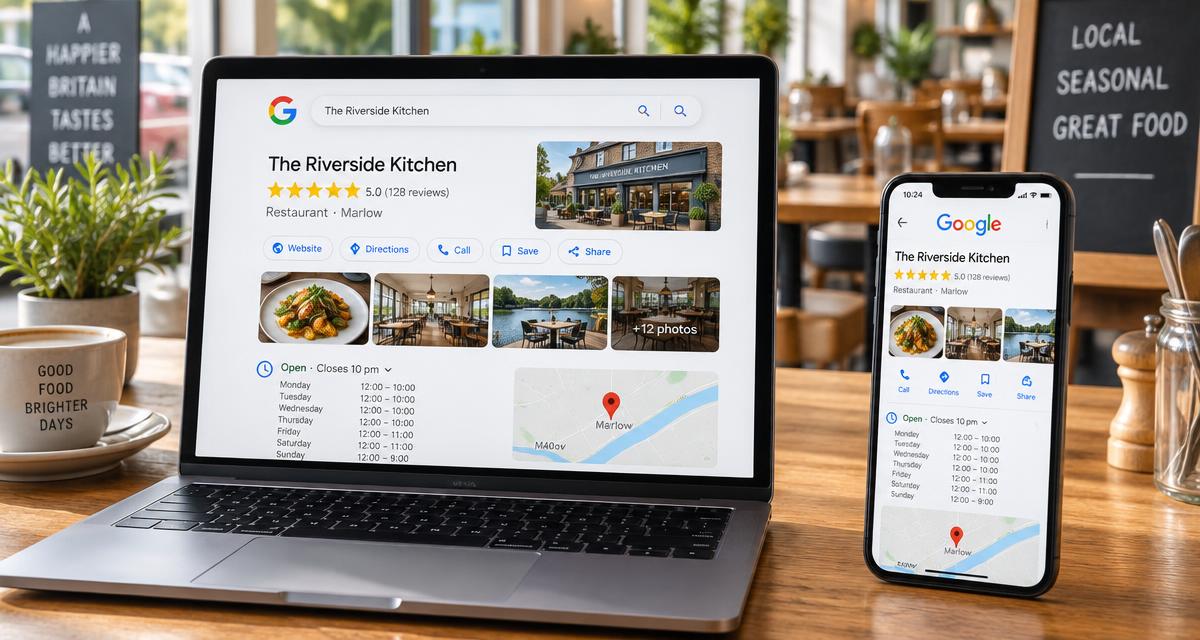
A Google Business Profile and a simple website do different jobs. Here is how to make them work together, without treating either as a replacement for the other.
Read article